Posts

The best part of the night shift....

Image
Sunrise. Mauna Kea at sunrise (Photo: Laney Hart) Sunrise over the seismic gear (Photo: Laney Hart)

Unspooling seismic streamer

Image
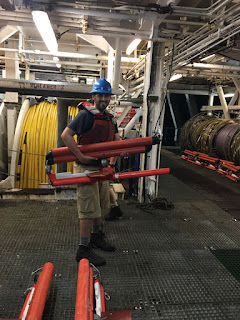
Dan Sousa, LDEO, carrying a 'bird,' which is used to control streamer depth. The streamer reel is in the background. Having finished the deployment of 70 OBS on the seafloor, we spent ~20 hours deploying the other key parts of the seismic gear for our project: a seismic “streamer” and a seismic source.   Seismic streamers are long cables filled with closely spaced hydrophones, which detect small pressure changes associated with passing sound waves.   The streamer for our program is ~10 miles long! It is stored on large reels, which unspool the streamer off the back of the ship and into the water. As we deploy the streamer into the ocean, we attach equipment to it that is used to control the depth of the streamer beneath the sea surface and determine its location behind the ship, which is very important for such a long cable.   The depth controllers have wings that can be pivoted to dive the streamer deeper or bring it shallower, so they are affectionately...

Knowledge sharing on the high seas

Image
Our first week at sea could often be described by the expression “Hurry up and wait!” When we are on station (the term used to describe being at the location where we deploy OBSs) everyone is working at full capacity. Whether it is technicians and students on deck preparing and launching the OBSs or the watch standers in the lab managing instruments and keeping careful records, everyone has a job to do and we all take our jobs seriously. However, the ocean is a rather large place, and the time it takes to go from one station to another can stretch. One might imagine all of us scientists running up to the top deck to get a marvelous Hawaiian suntan during these quiet periods, but the truth of what we are up to is even more exciting. We are having science meetings to discuss the aims and motivations of our study. Tony explains seismic profile acquired by R/V Conrad in 1982 Less than a week into our journey and we have had two science meetings, lead by principle investigato...

Ocean Bottom Seismometer Overboard

Image
The first week of the Hawaiian-Emperor Seamount Seismic Experiment has been filled with tossing things over the side of the ship – not throwing just anything overboard, but specifically deploying Ocean Bottom Seismometers (OBS) at regular intervals along transects of ocean floor specifically selected to help answer our science queries. While the crew of the R/V Langseth deftly avoided hurricane Olivia, the OBS technicians and the science party for our expedition have been working around the clock to achieve the first phase of our expedition goals – drop 70 OBSs to the seafloor, where they act as recording devices for the seismic waves that allow us to map the oceanic plate and upper mantle beneath Hawaii. OBS deployment OBSs are aptly named instruments – they consist primarily of a seismometer (just like the ones that record earthquakes all over the globe), a data logger with battery pack (to record what the seismometer picks up), an anchor (to keep the instrument on the seafloor...

Acclimating to life at sea and learning the ropes

Image
Deploying an ocean bottom seismometer (although this picture makes it look like we are setting the instrument on the horizon). We have been on the R/V Langseth for six days now. During that time, we've become accustomed to living on the ship, developed our sea legs, and acclimated to working odd hours of the night to maintain 24-hour operations. Hurricane Olivia resulted in rough seas for the first few days of the expedition, but it gave us a greater appreciation for calm weather and gentle seas. For many of the students onboard (including myself), this is our first experience acquiring marine seismic data. Everyone on the ship has been extremely helpful and willing to teach us how to safely and effectively handle the instruments, including ocean bottom seismometers (OBS).  We have already deployed 35 OBS!  Successful recovery of an OBS In addition to deploying OBS, we are also assisting in the recovery o...